AI decides who gets recommended.Make sure it’s you.
See where you stand in AI answers today, who is being recommended instead of you, and exactly what to change to take their place.
Get your free report in 60 seconds. No card, nothing to install.
Overview
Your AI visibility performance at a glance.
Visibility
Share of answers naming you, against the brands nearest you
Visibility score
55%3
named in 79 of 144 answers
- Rank
- #41
- Avg position
- 2.3no change
- Weakest engine
- 29%
- Sentiment
- 63%positive
Top sources
Cited often, and mostly without you
- sasalesforce.com45you in 19 of 45
- huhubspot.com52you in 32 of 52
- g2g2.com43you in 24 of 43
- rereddit.com37you in 21 of 37
- cacapterra.com32you in 17 of 32
Insights
Derived from this run, not written by a model
- Visibility improved on 11 promptsBiggest gains on "best CRM for a small business" and "CRM that a non technical founder can run".
- salesforce.com is deciding answers you loseThe engines cited it in 45 answers this run and named you in only 19 of them. Getting listed there is 26 answers of upside.
The shift
Search volumes are shifting from search engines to AI.
As people move from search engines to AI platforms, the way a buyer finds you is changing. Every major AI model now answers the questions that used to be searches, and each one is a new place to be discovered, or missed. Tracking that shift shows you where your audience is going and what to fix so you are there when they arrive.
Where AI search traffic goes today
Share of AI chatbot traffic worldwide, July 2026
- ChatGPT77.9%
- Gemini9.9%
- Perplexity5.9%
- Claude3.2%
- Copilot3.1%
2B
people a month see Google's AI Overviews, the answer that now sits above the links.
700M
people a week use ChatGPT. Half of what they send it is a question they want answered.
−25%
is the drop in traditional search engine volume Gartner forecast for 2026.
8%
of Google visits with an AI summary end in a click on a result, against 15% without one.
“Generative AI solutions are becoming substitute answer engines, replacing user queries that previously may have been executed in traditional search engines. This will force companies to rethink their marketing channels strategy.”
The product
Everything you need to be named in AI answers, in one place.
Track what the engines say about your brand, see who they name instead, find the pages that decide it, and get a fix list. Six capabilities, one dashboard.
Prompt tracking
The questions buyers type, asked on every engine, every run.
- best CRM for a small business
- best CRM for a startup sales team
- what CRM should a two person agency use
Visibility score
One number for how often you are named, and how it moved.
55%3
named in 79 of 144 answers this run
Competitor tracking
Every rival measured with the same formula, ranked against you.
- 1HuHubSpot81%
- 2SaSalesforce78%
- 3PiPipedrive64%
Citation sources
The pages the engines read before answering, and whether you were on them.
- huhubspot.comcited 52×
- sasalesforce.comcited 45×
- g2g2.comcited 43×
Every answer, in full
What each engine actually wrote, with every brand marked.
ChatGPT
Here are the options that come up most often, starting with HubSpot. Salesforce, Pipedrive, Fernway and Folk are also worth comparing.
Fix list
What to change, in the order it is expected to move the number.
“CRM that syncs with Gmail”
HubSpot named in 5 of the answers that missed you. Get on the pages they cite.
Prompt tracking
Track the questions your buyers actually ask, on every engine, every run.
These are not keywords. They are the sentences a person types when deciding what to buy. We draft them from your site, you edit them, and every one is asked on ChatGPT, Perplexity, Gemini and Claude and stored in full.
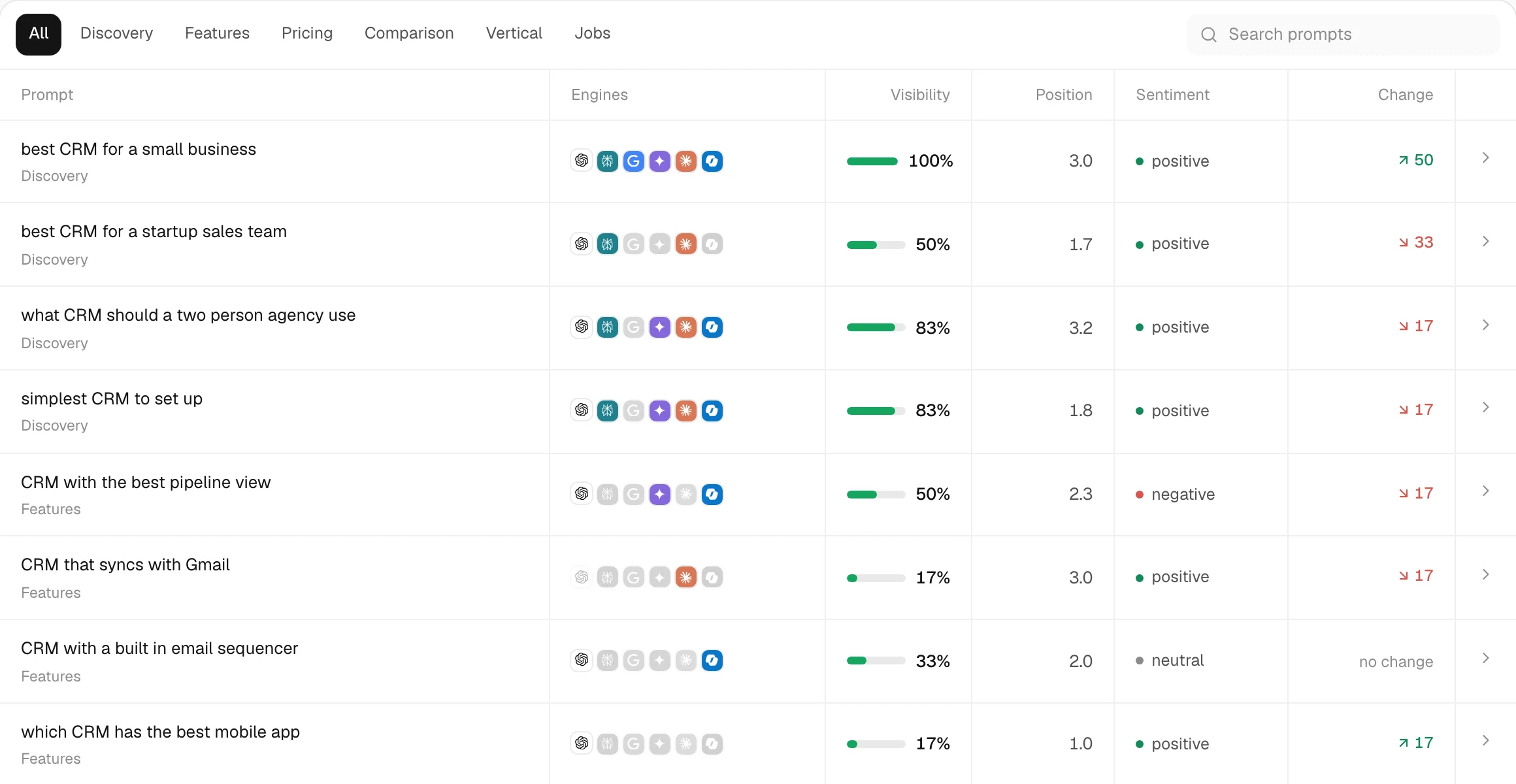
Fifty to six hundred prompts
Drafted from what your site sells, grouped by topic, editable at any time. Add your own in one line.
Every engine, every run
Each prompt goes to every engine you track on a schedule you set. Nothing is sampled.
Position, not just presence
Whether you were named, and how far down the list. Third place and first place are different answers.
Change since last run
Every row shows the move since the previous run, so a drop is noticed the day it happens.
Competitor tracking
See who the engines name instead of you, measured the same way.
Every rival that appears in the same answers is scored with the same formula you are, so the ranking means something. You find out you are fourth behind HubSpot before your buyers do.
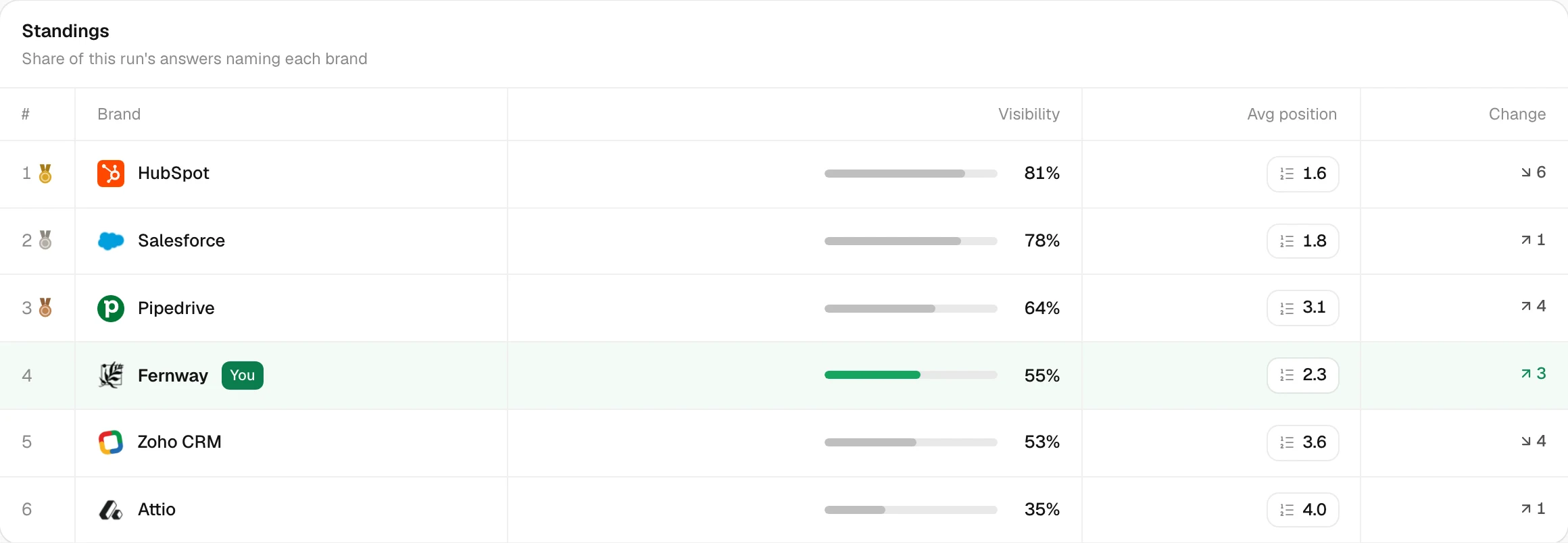
Standings
Every tracked brand ranked by the share of answers naming it, with average position and change.
Discovered rivals
Brands the engines keep naming that you did not list. One click to start tracking them.
Answers you are losing
The prompts where a rival was named and you were not, and who took them.
Trend against the field
Twelve runs of history for you and the four brands nearest you, on one chart.
Citation sources
Find out why you are not in the answer: the pages that decided it.
Before writing a word, each engine reads a handful of pages. We record every one it cites, group them by domain, and show how often you were named alongside each. A domain cited in forty answers that names you in three is a specific, fixable gap on a page somebody else owns.
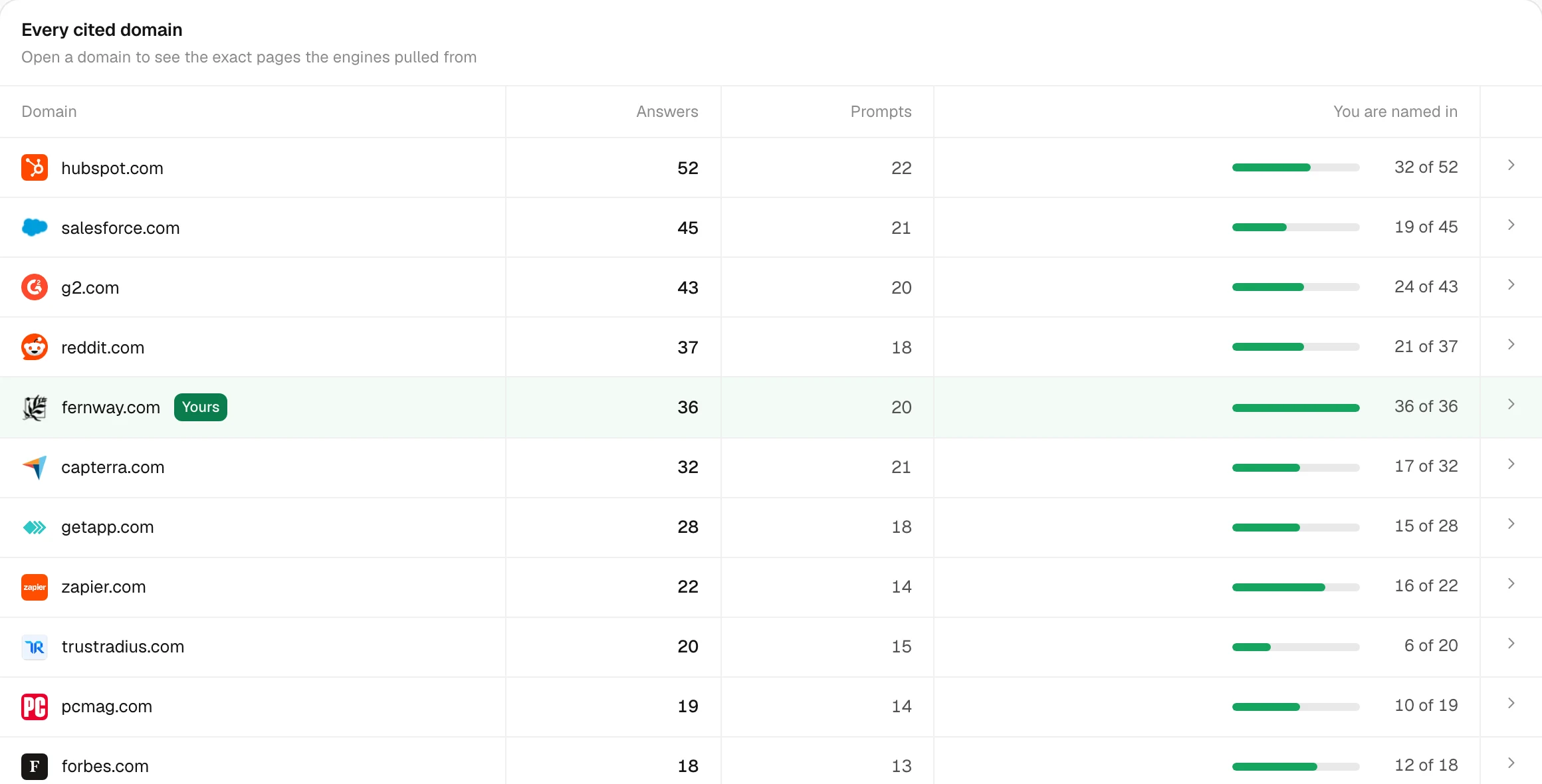
Every cited domain
Ranked by how many answers cite it, with the exact pages behind each one.
Named alongside
Of the answers citing a domain, how many also named you. The column that turns a list into a to-do.
Your own pages
Which of your pages the engines read, and which they could not.
Per prompt
Open any question and see the pages that shaped each engine's answer to it.
Fix list
Get a fix list in priority order, and find out afterwards whether it worked.
Every recommendation names the number it came from and the number it should move. Do the top one, and the next run tells you whether it worked, including when nothing changed.
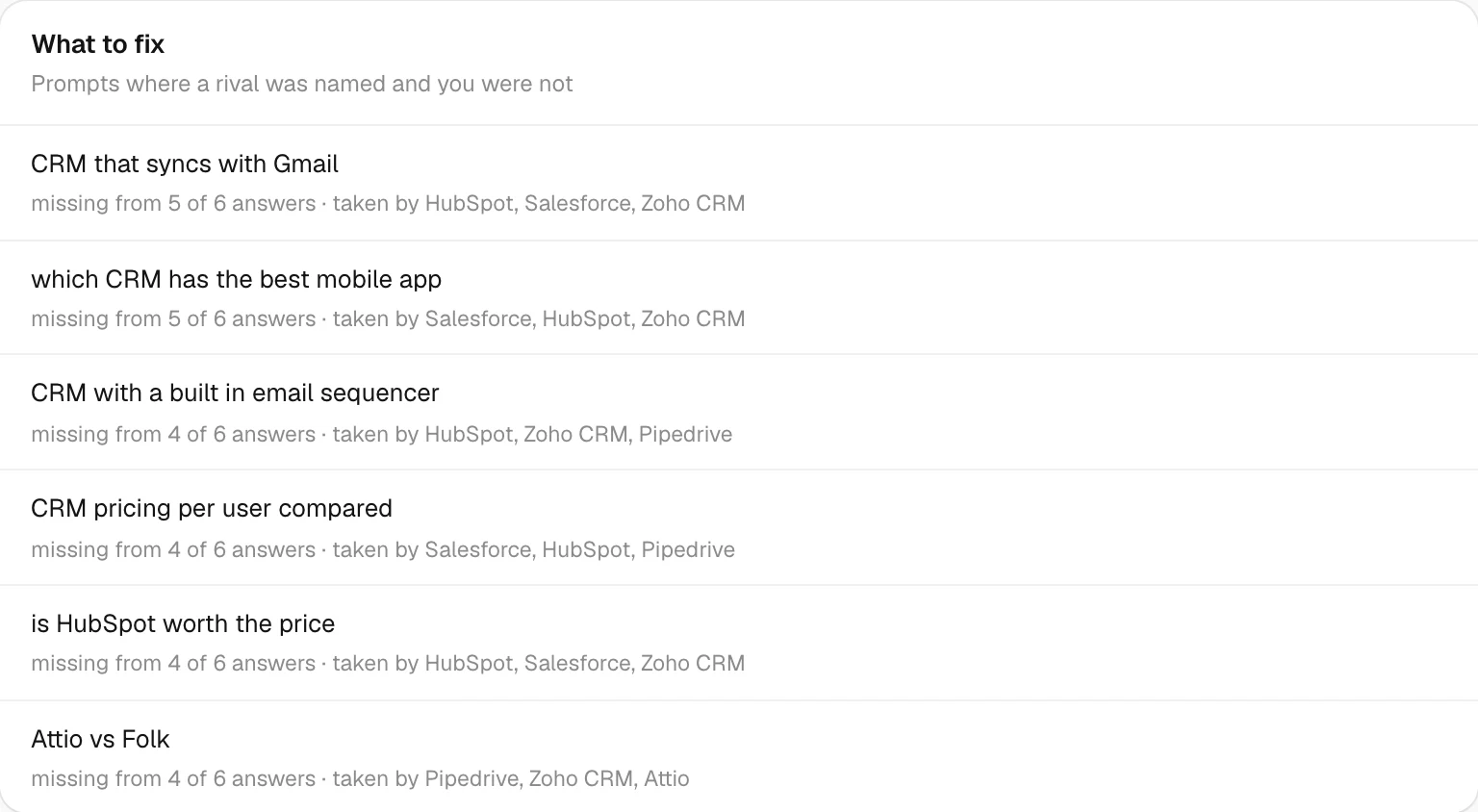
Ordered by expected gain
The prompts and pages where a change is expected to win the most visibility come first.
Named after the evidence
Each item points at the answers and citations it came from, so nothing is a guess.
Measured after the fact
The run after you act shows the move, up, down or flat, next to the item.
The report
The four screens in one printable column, for whoever asked why the numbers moved.
How it works
From a domain to your first answers in about ten minutes.
01
Paste your domain
The scan reads your site, works out your category, your buyers and your competitors, and drafts the prompt set. You correct anything it got wrong.
02
Tracking starts
Every prompt, on all six engines, every day. First results land in about ten minutes.
03
Fix what it found
A fix list in priority order, each item naming the number it should move, plus the article drafted against the prompts you keep losing.
Then open any questionand read exactly what each engine said.
Every prompt opens into its full analysis: where each engine placed you, run after run, every brand it named instead of you, and the exact pages that shaped each answer.
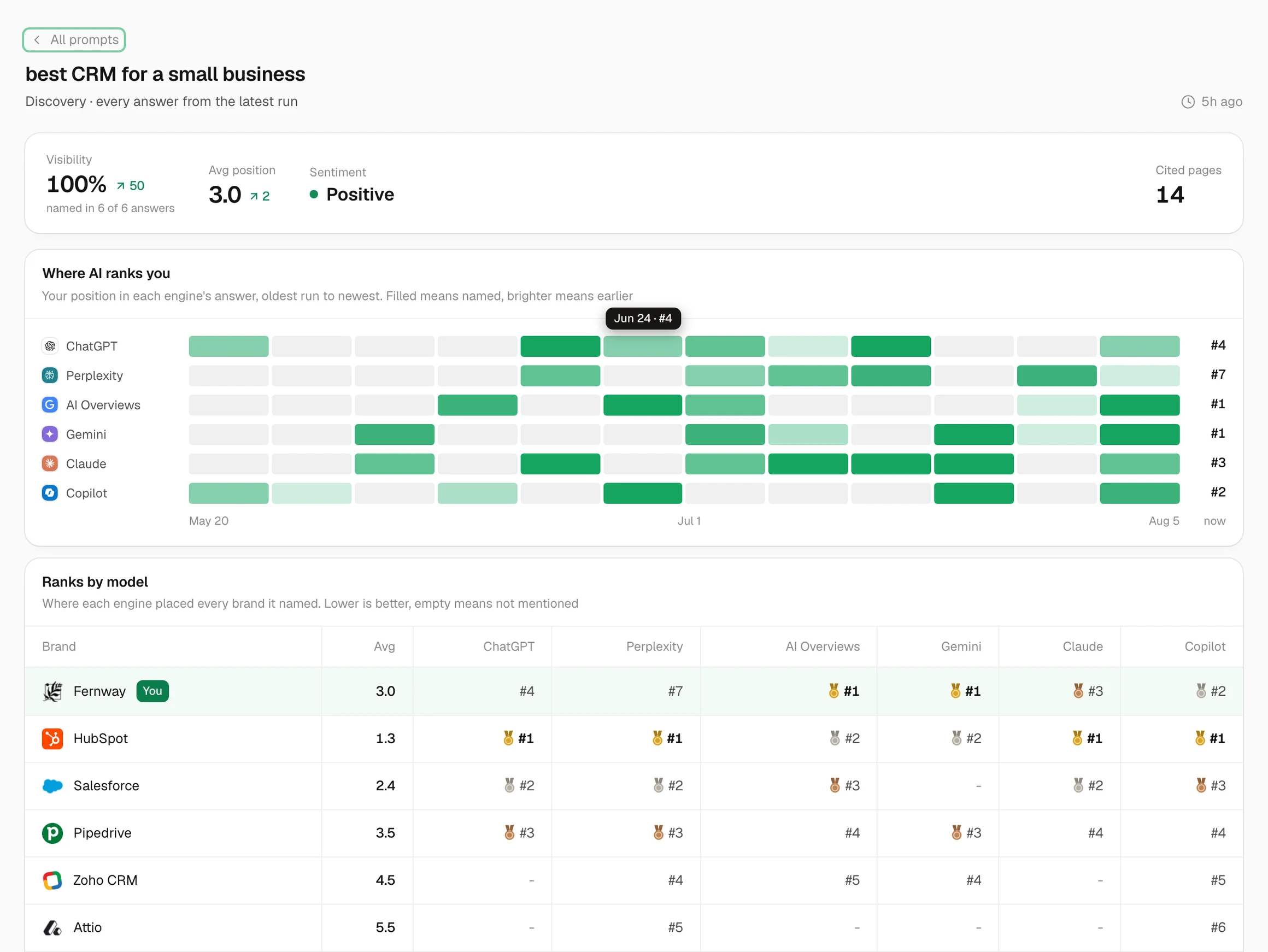
#1
on Gemini and AI Overviews
How an answer gets made
AI doesn’t rank you like Google does.It reads the web and decides who to recommend.
Before it writes a word, an engine searches and reads a handful of pages. Whoever is named in those pages is who ends up in the answer.
best CRM for a small business
g2.com
names 5 brands
reddit.com
names 3 brands
trustpilot.com
names 4 brands
youtube.com
names 2 brands
Your brand
not namedFor a team of two, most people land on Zoho CRM13, Pipedrive2 or Freshsales4. All three are inexpensive and quick to set up.
4 sources cited · none of them name you
None of those brands outranked you. They were simply in the pages the engine read, and you were not. That leaves you two places to win: your own pages have to be worth quoting, and you have to show up on the third-party pages the engines keep citing. PromptSEO shows you both, and which one is costing you more.
Frequently asked questions
Learn how AI visibility monitoring works and how PromptSEO helps your brand get named in AI answers.
Yes. Every prompt hits the engines themselves, every day. No scraping, no single-run 'rankings', no extrapolation. You can open any captured response and read exactly what the engine returned, including the pages it built the answer from.
Rank trackers report a position. Engines do not return a ranked list, they return an answer that either names you or does not. We report how often you are named, on which prompts, who gets named instead, and which sources the answer was built from.
Six, on every plan including the cheapest. We do not gate engines behind a tier, and we do not name an engine we are not actually running.
Every day, on every plan. You see an answer change the day it changes, rather than finding out a week later that something moved and not knowing when.
Starter covers one project. Pro covers three and Scale covers ten, so sub-brands, separate regions or a small portfolio all run from one account.
Every prompt you lose turns into a fix list item that names the number it should move, in priority order. Where the fix needs a page written, the article is drafted against that specific prompt and structured the way engines quote, ready to paste into your site.
Yes. MCP access is on every plan, so Claude or ChatGPT can query your visibility data directly and answer questions about it. Pro and Scale add a full REST API.
No. Paste a domain and the prompt set is drafted for you. Every recommendation names the number it came from and what it should move, so nothing here assumes you have read a single thread about generative engine optimisation.
Any time, from the dashboard. No contracts, no minimum term, no call to book.
Find out where you stand. It takes 60 seconds.
Paste your domain, and read what six engines are already telling your buyers.